Neither Zellige nor Subway Tile: These Small Retro-Chic Tiles Are Making a Comeback in Our Kitchens

In recent seasons, kitchen backsplashes in a checkerboard pattern or zellige have taken over, often alongside the iconic white subway tile. Yet this pairing is starting to be associated with 2010s kitchens, as several design magazines point out. Designers are turning toward something else—more intimate, warmer. And the answer lies in a format that many of us thought belonged to old houses.
According to Phoebe Hollond of the Studio Hollond, quoted by Vogue, “Beautiful hand-painted tiles bring back a nostalgia that is much softer and warmer.” Hackrea notes the same wave: hand-painted tiles are reappearing boldly as a full backsplash or as a panel behind the range hood. Behind this trend is above all the desire for a kitchen that looks lived-in at first glance.
The Return of Hand-Painted Tiles as a Kitchen Backsplash
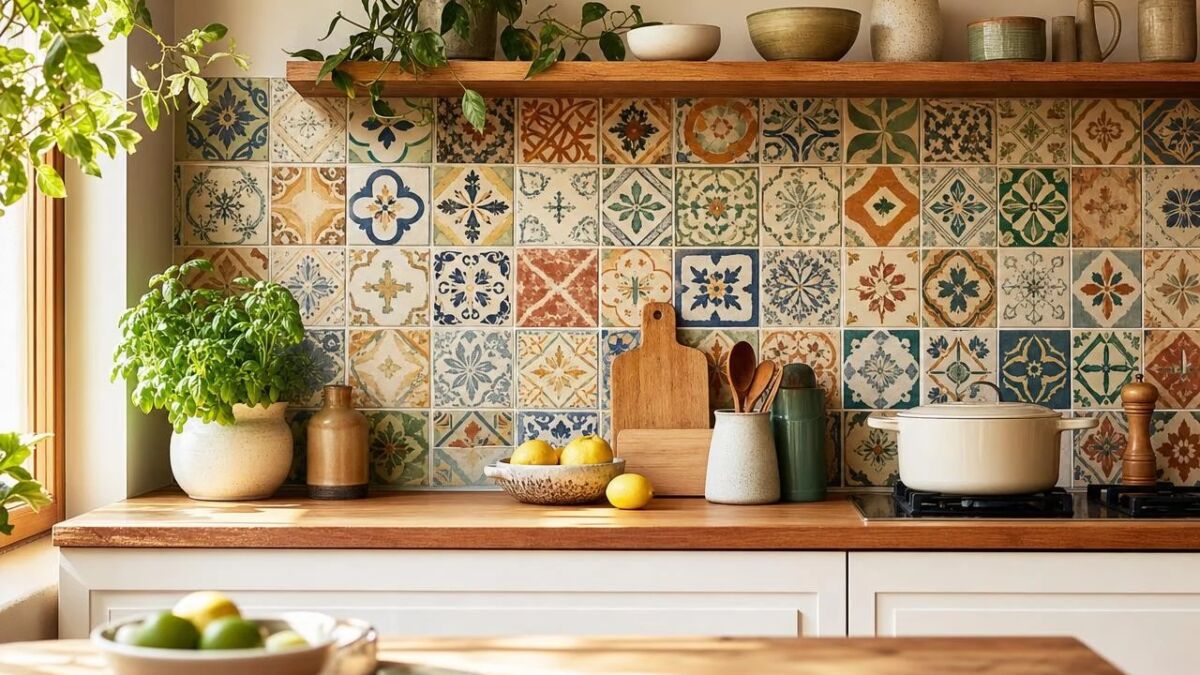
Where the checkerboard plays with rhythm and zellige with texture, these small tiles focus on the design itself. Vogue describes a clear shift: backsplashes with a chessboard tile feel give way to a much more pictorial tiling style, almost like a ceramic frieze. Ceramist Freyja Lee has imagined a custom floral setting for a project by Heidi Caillier, turning the entire wall into an illustration.
At Balineum, the Egyptomania collection, hand-painted by French artist Louis Barthélemy, creates the same effect of a wall tableau behind the work surface. Other names, such as Petra Palumbo with revisited Delft tiles or Douglas Watson with the Fran Davidson Blossoms series, play the joyful motif card. In all cases, the backsplash becomes a kind of wall comic strip that tells a story, far from the simple white metro backdrop.
What Do These Tiny Antique Tiles Really Look Like?
Behind the expression small antique tiles, there is mainly small square formats decorated with a motif: flower, shell, countryside scene, little figure. The most telling example remains Delft tiles, this Dutch craft with a very old tradition where a deep blue—the famous Delft blue—stands out on an off-white background. They frequently depict landscapes, boats, or everyday scenes.
Livingetc reports that this blue today can be mixed with simple white or ivory tiles to lighten the overall look, a bit like a collage of faïence. Some brands, such as StoryTiles, even have fun modernizing the subjects while keeping the traditional frame. Maison et Travaux notes that white subway tile with dark grout now reads as very dated: a backsplash in hand-painted tiles becomes the new visual signature, especially when it climbs to 50 or 70 centimeters in height, or even higher.
Where to Place These Tiles for Maximum Charm Without Overload
Hackrea notes that these motifs work very well as a full backsplash, but also as a limited accent zone. Behind the range hood, a few rows of decorated tiles framed by plain tiles create a real scene, without taking over the entire room. This “insertion of motifs” lets you enjoy the drawing while keeping surrounding surfaces calmer, especially if the cabinet fronts stay understated. To choose the placement, three scenarios stand out.
- a backsplash behind the hood, fully decorated around the cooktop;
- a band of hand-painted tiles running along the length of the countertop;
- a small coffee wall or niche, dressed with motifs only there.
Staying restrained also helps: a limited palette, one or two colors, grout close to the background. With this balance, a few hand-painted tiles are enough to change the kitchen’s mood, without a sense of overload.