How to Choose Blinds for Better Room Comfort

Before diving into a purchase, it’s best to take the time to consider a few essential criteria: the window’s orientation, how the room will be used, the exact dimensions, the material, and how easy it is to maintain. One point to emphasize right away: no shade, no matter how effective, will ever replace proper ventilation or solid thermal insulation.
Identify the needs of each room
Consider the window orientation
The orientation of a window plays a decisive role in the brightness and warmth felt inside. A south-facing window endures strong sun for much of the day, while an east-facing one brings morning light that can be hard to bear, and a west-facing exposure concentrates heat in the late afternoon. In rooms that are especially exposed, opting for a modulable protection (one that lets you adjust the level of light as needed) is often a wise choice. Solar protections do help limit heat gains, but they reach their full potential only when paired with effective ventilation.
Tailor the choice to the room’s use
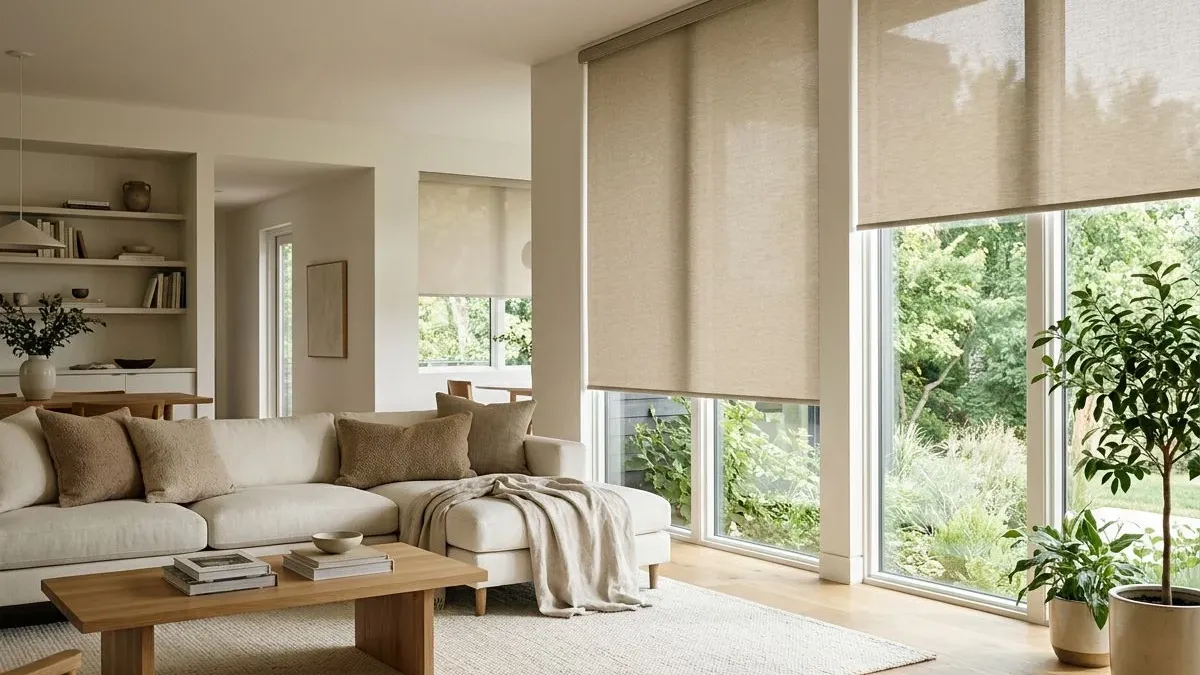
Not all rooms have the same requirements. In a bedroom, priority is given to blackout, privacy, and quiet operation to avoid being awakened by a noisy mechanism. In a living room, the goal is different: to strike a balance between natural light and glare reduction. An office, meanwhile, mainly requires limiting reflections on screens without plunging the room into gloom. For kitchens and bathrooms, materials that resist humidity and are easy to clean are essential — you don’t often think about this detail until you’re faced with the problem.
Compare the main types of blinds
Sheer, semi-opaque, and blackout blinds
These three categories mainly differ in how much light they let through or block. A sheer fabric typically preserves good brightness while reducing visual intrusion, making it a versatile solution for many living spaces. Blackout fabrics, on the other hand, are more suited to bedrooms or areas where tighter control of light is necessary. There isn’t a universally superior model; it all depends, once again, on the actual use of the room.
Venetian, roller, and Roman blinds
These three styles differ in their level of adjustability, footprint, and aesthetic. The Venetian blind offers the ability to tilt the slats to finely tune the entry of daylight. The roller blind, being more discreet and compact, integrates easily into most interior styles. The Roman blind, meanwhile, relies on fabric that folds into soft pleats, adding a warmer touch. For windows with unusual dimensions or when a particularly polished look is sought, a custom Roman blind can be a relevant solution.
Check the technical criteria before buying
Take proper measurements
Accurately measuring the width and height of the glazing, the frame, and the space around the window remains a key step. It’s also important to determine whether the installation will be on the sash, within the frame, or on the wall, while verifying the space required for the mechanism and the fabric when the shade is retracted. One detail not to overlook: even windows that look identical to the naked eye deserve to be measured separately, as the gaps can be more significant than you might imagine.
Choose the material and the level of transparency
The fabric’s density directly determines how much light is filtered. Synthetic materials generally facilitate daily maintenance, while natural textiles appeal with their decorative look. It remains essential to check resistance to humidity, UV exposure, and deformation depending on the room, but do not confuse blackout fabric with true thermal insulation — two concepts that are sometimes conflated.
Preserve air quality and durability
A shade should never obstruct air intakes or hinder the proper operation of ventilation equipment. It’s also recommended to air out your home for 10 to 15 minutes each day, even in winter. For maintenance, regular dusting with a vacuum cleaner equipped with a soft brush, or simply with an appropriate cloth, can significantly extend the fabric’s life. It’s also wise to strictly follow the manufacturer’s washing instructions to avoid shrinkage or deformation. Finally, cords or chains deserve particular attention and regular checks, especially in homes with young children.
Note: an effective solar protection should improve comfort without ever compromising air renewal. The air inlets and ventilation ducts must remain clear.
Practical example: choosing a shade for an east-facing bedroom
Let’s take a concrete scenario: a bedroom oriented to the east, basking in light from the early morning hours. Here, the priorities are clear: reduce glare, preserve privacy, and ensure quality sleep. A sheer fabric will suit people who aren’t highly sensitive to morning light, while a blackout fabric will be preferable for those who want to extend their sleep without being disturbed by the sunrise. If the window is narrow, located next to a piece of furniture, or has an unusual shape, precise measurement becomes almost mandatory. The final decision will, of course, also depend on the existing decor, the budget available, and the ease of use sought on a daily basis.
Pour bien choisir, partir de l’usage avant l’esthétique
Ultimately, the choice of a shade rests on several complementary criteria that must be coordinated: the window’s exposure, the function of the room, the desired level of light control, the precise dimensions, the material, and the necessary maintenance. Observing the variations in light at different times of day before making a decision often helps refine the choice considerably. A successful shade is, above all, one that meets a concrete need while integrating durably into the room, and not merely one that flatters the eye at first glance. It’s better to compare solutions methodically rather than be swayed solely by appearance or fleeting trends.