Bioclimatic Pergola: Why Start Your Project This Fall

The first rays of sunshine often make you want to spruce up the terrace. Yet manufacturers and installers can already be in high demand at this time. If you’re considering installing a bioclimatic pergola, you’ll need to plan several steps before installation. By starting the project in autumn, you have several months to make decisions and organize the work before spring 2027.
Why prepare your bioclimatic pergola in autumn?
A bioclimatic pergola project, whether attached or freestanding, begins well before the installers arrive. You must first specify the dimensions, study the site layout, and select the equipment. For a custom aluminum pergola, the manufacturer must then prepare the plans and start fabrication.
Administrative steps can also extend this timeline. In particular, you need to file a prior declaration or apply for a building permit early enough. The town hall must review the file before giving its answer, which can take several weeks. Adjustments may also be requested depending on local regulations. By checking as early as October or November, you’ll have more time to gather the necessary documents.
Installers also tend to have more availability out of season. You can request a technical visit, compare several quotes, and discuss installation constraints. Timelines vary, however, depending on the companies and the project’s characteristics. It’s best to confirm them before setting a date.
How to define the use of your pergola before choosing a model?
The planned layout helps determine the necessary area. A family dining table, a garden lounge, and an outdoor kitchen do not occupy the same space. Also plan for circulation around the furniture and access to doors.
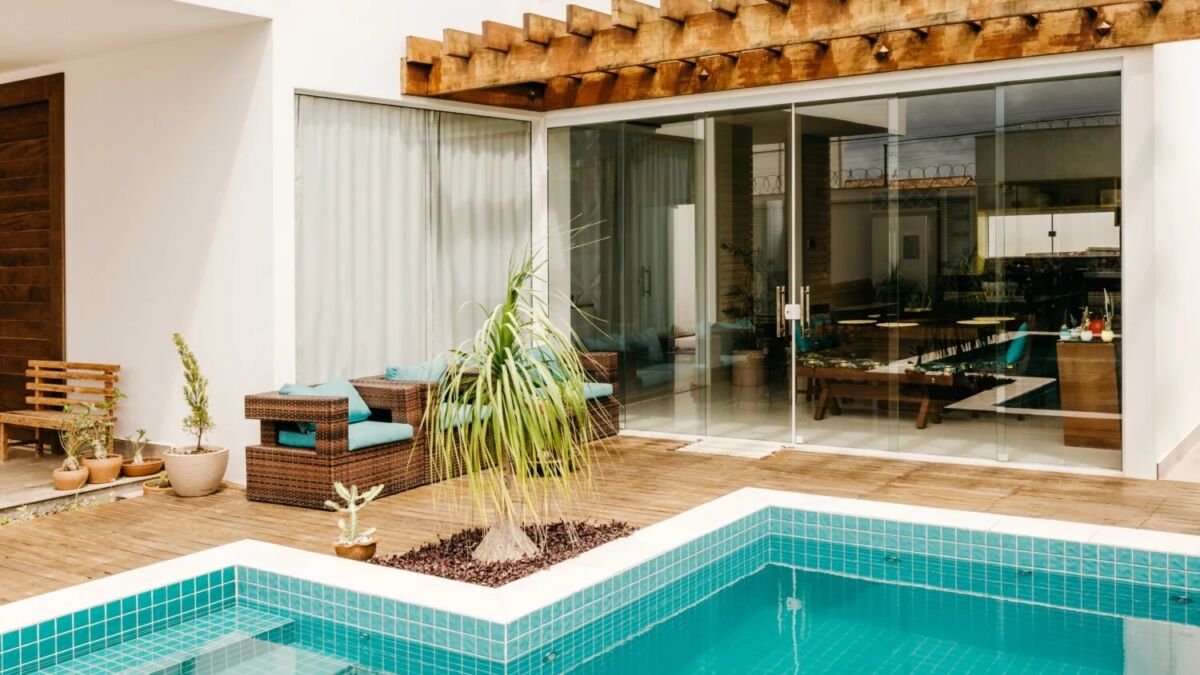
Near a pool, the desired shade may vary throughout the day. For a terrace adjoining the living room, the continuity between indoors and outdoors matters more. Orientation, prevailing winds, and sightlines also deserve consideration.
A measurement of dimensions and a few photos of the site will ease discussions with the manufacturer. You’ll be able to explain your needs from the first appointment. This preparation limits late changes to plans and equipment.
Bioclimatic pergola – attached or freestanding: which to choose?
The attached bioclimatic pergola is fixed against the house façade. It extends the terrace and streamlines the transition between living space and outdoor areas. Before choosing this configuration, you must check the wall’s solidity and the feasibility of the fixings.
On the other hand, the freestanding bioclimatic pergola has its own posts. It can be installed in the middle of the garden, near a pool, or in a space away from the house. Its placement offers more freedom, but the ground anchors must withstand the site constraints and wind.
To compare the two models, several criteria should be examined:
- Orientation: observe the sun’s path and the shade areas at the times you’ll use it.
- The façade: check its condition, its composition, and its ability to receive the fixings of an attached pergola.
- The site: measure the available area and identify obstacles, accesses, and buried networks.
- The wind: study the garden’s exposure and the anchoring needs of the structure.
- The proximity to the house: an attached installation eases foot traffic, while a freestanding model creates a separate space.
Plans and site constraints will help you decide. A technical visit will then confirm the installation’s feasibility.
Administrative steps to anticipate before spring
The formalities depend on the pergola’s footprint, its location, and the applicable urban planning rules. A prior declaration of works may suffice in some cases. Other projects require a building permit. The thresholds defined by regulations must be checked according to the site and the nature of the installation.
The local urban planning plan (PLU) may impose additional restrictions. It can govern aspects of the structure’s appearance, its location, or the materials allowed. In a protected sector, special rules may also apply.
Contact your town hall’s urban planning department before ordering the pergola. They will tell you the formalities related to your project and the documents to provide. This early check reduces the risk of having to modify plans after they’re prepared.
Options to enjoy your pergola by spring
A pergola with adjustable louvers helps modulate sunlight and ventilation. Depending on the model, the slats can be controlled remotely. This feature makes it easier to adjust settings when lighting or weather changes.
Other equipment addresses specific needs. LED lighting extends evenings on the terrace. A rain sensor can automatically close the slats if the system supports it. Vertical blinds reduce harsh sun and some wind effects. They also limit outside views depending on their position.
Privacy screens enhance seclusion, especially in gardens near neighbors. Sliding glass panels provide more wind and temperature protection. They make the space more comfortable during shoulder seasons, without turning the pergola into a heated room.
What budget should you plan for a bioclimatic pergola?
The price of a bioclimatic pergola varies according to its size, model, and chosen options. A freestanding pergola might require different foundations than an attached model. The site condition and access to the construction site also influence installation costs.
Motorization, lighting, blinds, and sliding glazing also affect the budget. You may need additional work, such as laying a concrete slab or installing an electrical supply.
Ask for a detailed quote that separates the pergola price, equipment, installation, and ancillary works. Compare several quotes before making your choice. This will allow you to tailor the project to your budget before fabrication begins.
How to choose your bioclimatic pergola manufacturer?
To pick a manufacturer, compare materials, warranties, available options, and post-installation support. Also check whether production is domestic and whether the manufacturer has a network of installers.
Founded in 2009, Biossun operates a 6,000 m² plant in Sassenage, Isère. The company designs and manufactures its pergolas in France using recyclable aluminum.
Its models feature patented S-shaped blades designed to promote natural ventilation. Biossun also claims more than ten patents, a ten-year warranty, and a Qualicoat-certified surface treatment. Be sure to verify the warranty terms for the model you choose.
By comparing manufacturers in autumn, you’ll have time to study quotes, choose equipment, and plan the installation before spring 2027.
Frequently Asked Questions
Does a bioclimatic pergola increase my property tax?
Generally, no. An open pergola is not considered a closed habitable space. It does not affect property tax, unlike a veranda. It’s still wise to check with your town hall.
Can you install a bioclimatic pergola without a building permit?
Yes, in most cases. A prior declaration suffices for areas between 5 and 20 m² (up to 40 m² in urban PLU zones). Below 5 m², no formalities are required.
What is the difference in watertightness between flat blades and S-shaped blades?
Patented S-shaped blades channel rainwater effectively toward integrated gutters. Their shape provides significantly better sealing when closed compared to traditional flat blades.