
This 1950s Golden Pot Could Be Worth a Fortune Thanks to a Rare Signature: A Similar Set Sold for Nearly €12,000

In flea markets, rummage sales, or family china cabinets, some objects catch the eye without us guessing their true value. This is especially true of small golden ceramic pots, once used as decorative pieces. With their delicate motifs and sometimes surprising colors, they seem to belong to another era. Yet some of these vintage pieces are now highly sought after by collectors.
An example showcased by the auction house Artcurial provides a perfect illustration. Hidden behind its lid and gilded décor lies the work of a renowned French ceramist, whose creations can command impressive sums. This item, estimated at €5,000 to €8,000, ultimately found a buyer for €11,916. A reason to take a closer look at the old ceramics tucked away in our cupboards.
This Golden Ceramic Pot Hides the Signature of a Highly Sought-After French Artist
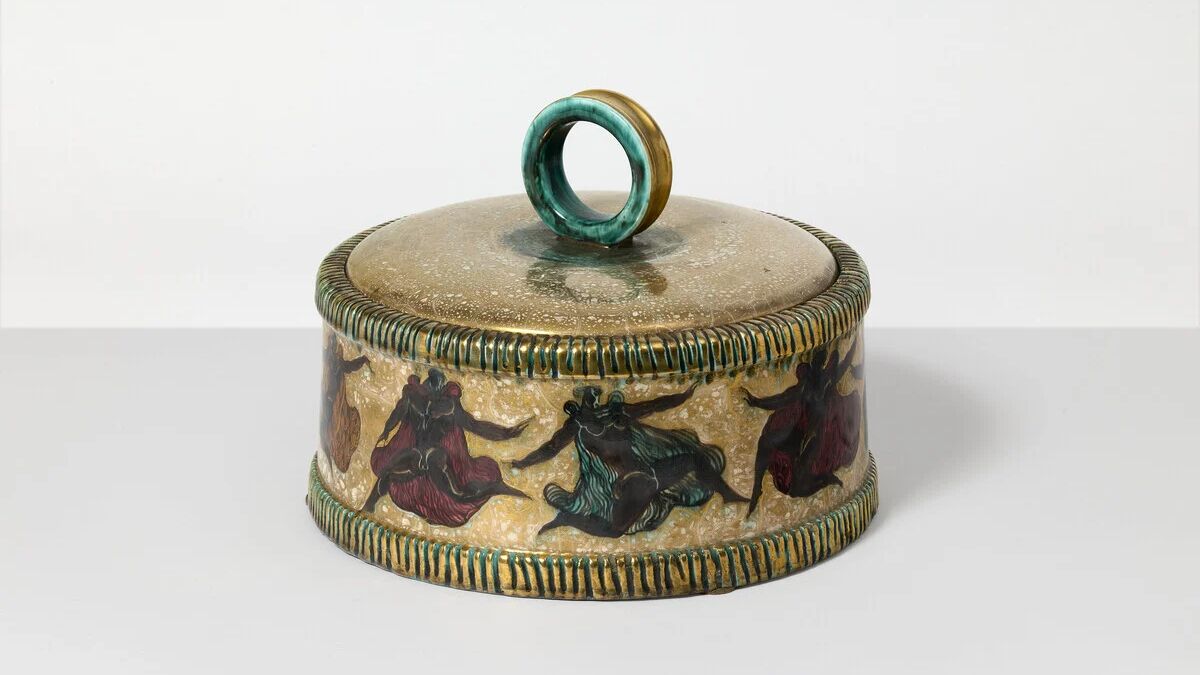
At first glance, it might simply be a pretty antique decorative pot. Yet this piece, presented by Artcurial, possesses several characteristics that set it apart from ordinary ceramics. Crafted around 1940, it measures 23 centimeters tall by 28 centimeters wide. Its surface is coated with a polychrome enamel, enhanced with gilding, on which dancers appear. A meticulously worked design that testifies to the craftsmanship of early 20th-century artistic ceramic ateliers.
But the most intriguing detail is on the reverse. The piece bears the monogram of Jean Mayodon and the inscription “Sèvres”, both written in gold. These markings identify a creation made for the famous Manufacture de Sèvres. Jean Mayodon, born in 1893 and died in 1967, was a French ceramist known for works with refined designs, often inspired by Antiquity. His characters, his deep colors, and his gilded highlights give his creations an identity that is immediately recognizable to 20th-century ceramic enthusiasts.
Why Did This Small Antique Pot Fetch Nearly €12,000 at Auction?
The value of this piece rests on more than its appearance. The signature of Jean Mayodon, its association with the Manufacture de Sèvres, and the quality of its decoration are all elements that can attract collectors. The piece’s provenance also plays an important role. According to Artcurial, this pot previously belonged to the Geneviève and Pierre Hebey collection. It had been shown during a Paris sale on February 23, 2016, before joining the collection of its last known owner.
At the time of the auction, the selling house had set an estimate between €5,000 and €8,000. But bidders went further: the covered pot was ultimately awarded for €11,916, including fees according to the result published by Artcurial. A remarkable sum for an object whose dimensions remain relatively modest. However, one should not generalize: not all antique gilded pots carry such value. This result pertains to a work identified, attributed to a renowned artist, and accompanied by documented provenance.
Important Jean Mayodon Covered Pot – circa 1940
Flea Market and Sideboard: Details to Check to Identify a Valuable Antique Ceramic
If you own an old covered pot, a vase, or a decorated ceramic box, start by carefully examining its base. Signatures, monograms, maker marks, and numbers can provide valuable clues about its origin. In the case of Jean Mayodon’s creations, inscriptions can notably point to the artist’s name or to the Sèvres Manufacture. You should also observe the patterns, the quality of the glaze, and any gilding. These characteristics can help guide research, but they do not, by themselves, authenticate a piece: some marks have been reproduced, and items that look similar may have very different origins.
The condition of preservation is another essential criterion. An original lid, the absence of major cracks or poorly executed restorations can influence buyers’ interest. If you think you’ve discovered an interesting antique ceramic, avoid cleaning it with abrasive products or attempting to repair a chip yourself. Photograph the object from several angles, including the inscriptions underneath, then seek the opinion of an auctioneer or a specialist. Because behind a small pot forgotten for decades in a sideboard can sometimes lie a genuine collectible. Still, one must be able to identify its creator precisely.
Keep reading
 Decor Styles If You Grew Up in the 90s, This Christmas Tree Will Bring Back Memories: Multicolored Garlands and Mismatched Ornaments Are Making a Comeback
 Decor Styles 1960s White Plates With Green Leaf Pattern Worth Almost $1,000, Say Collectors
 Decor Styles 1845–1950 Item Dazzled Sunday Tables; Collectors Pay High Prices