No More Entryway Shoe Shelf: Decorator Alternatives Under 15 cm

Who hasn’t had to angle themselves to pass by a bulky shoe rack jammed behind the front door? In many homes, this floor-standing piece narrows passage, catches the eye, and leaves pairs scattered. Interior designers have gradually banished it from their projects.
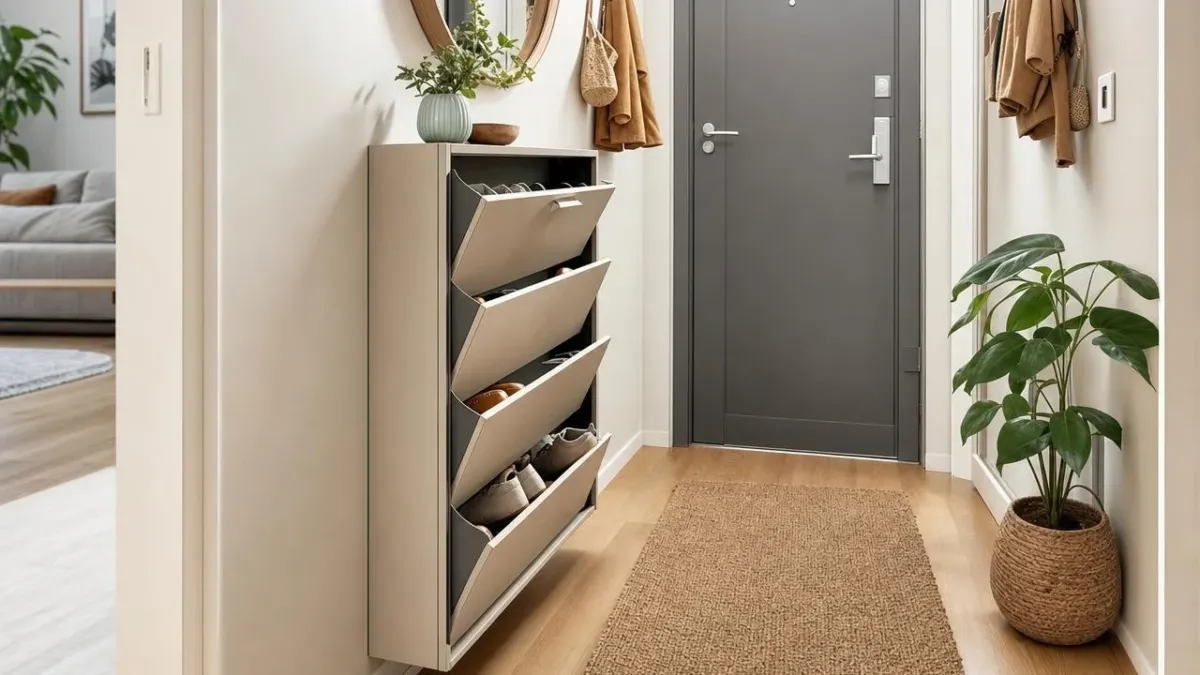
In contemporary entryways, they prefer a wall-mounted shoe cabinet with drop-front doors, exceptionally slim, that nearly vanishes into the wall. This new generation of storage designed for tight hallways isn’t more than 15 cm thick and it shifts the way space is laid out. The object stays discreet, but the transformation is dramatic.
Why the traditional shoe shelf clutters the entry
For years, the shoe shelf seemed obvious: a low piece on the floor, about thirty centimeters deep, where you line up the pairs. In a small entry, this bulk blocks the view and visually narrows the hallway. Soles, laces, and heels stay visible, which immediately conveys a sense of clutter.
Design professionals also point to another flaw: this low piece attracts dust and often clashes with the rest of the décor. In a home, the entry acts as the first scene. If the eye lands first on a heap of shoes, the sought-after sense of light and welcome vanishes at once.
The 15 cm-deep wall-mounted shoe cabinet, the new star of the entry
To solve this puzzle, decorators bet on a wall-mounted shoe cabinet with drop-front doors, about 15 cm in depth. Fixed to the wall, it no longer touches the floor. Shoes slide vertically into tilt-front compartments that open with a simple gesture. Depending on the chosen width, each door typically holds three to four pairs.
This shallow depth changes how space is perceived. The floor remains entirely clear, light flows through, and the silhouette of the cabinet reads as a graphic panel rather than a bulky functional block. Metal, particularly matte lacquered steel, enables a very slim structure. Other models rely on light wood, lacquered MDF, or ribbed façades for a warmer look.
How to choose and install this ultra-thin wall storage
To pick the right model, it all starts with measurements. Available wall width, ceiling height, and the number of daily shoes to store guide the decision. For a narrow entry, decorators advise staying around 15 cm in depth. Several simple benchmarks help:
- The number of drop-front doors, matched to the volume of shoes to store;
- The capacity per door, usually three to four pairs;
- The finish of the unit, in lacquered metal, wood, or glossy or matte lacquer;
- The opening mechanism, via a slim handle, notch, or discreet push-pull system;
- The wall type, which determines the anchors and screws needed for mounting.
For installation, professionals recommend mounting the wall-mounted shoe cabinet slightly above the baseboards, about fifteen centimeters from the floor. This gap eases cleaning and visually lightens the overall look. On brick or concrete walls, suitable anchors are sufficient; on a gypsum board partition, expansion metal anchors secure the cabinet’s load.