
Guillaume de Tonquédec: The Eleven-Tower Brittany Castle Named After Him

Behind certain famous names hide extraordinary family stories. This is notably the case with Guillaume de Tonquédec, known for his roles in Fais pas ci, fais pas ça or Le Prénom. While the actor built his career on stage and in front of the cameras, his surname tells a different story, one about a Breton family tied to a medieval castle whose origins go back to the 12th century.
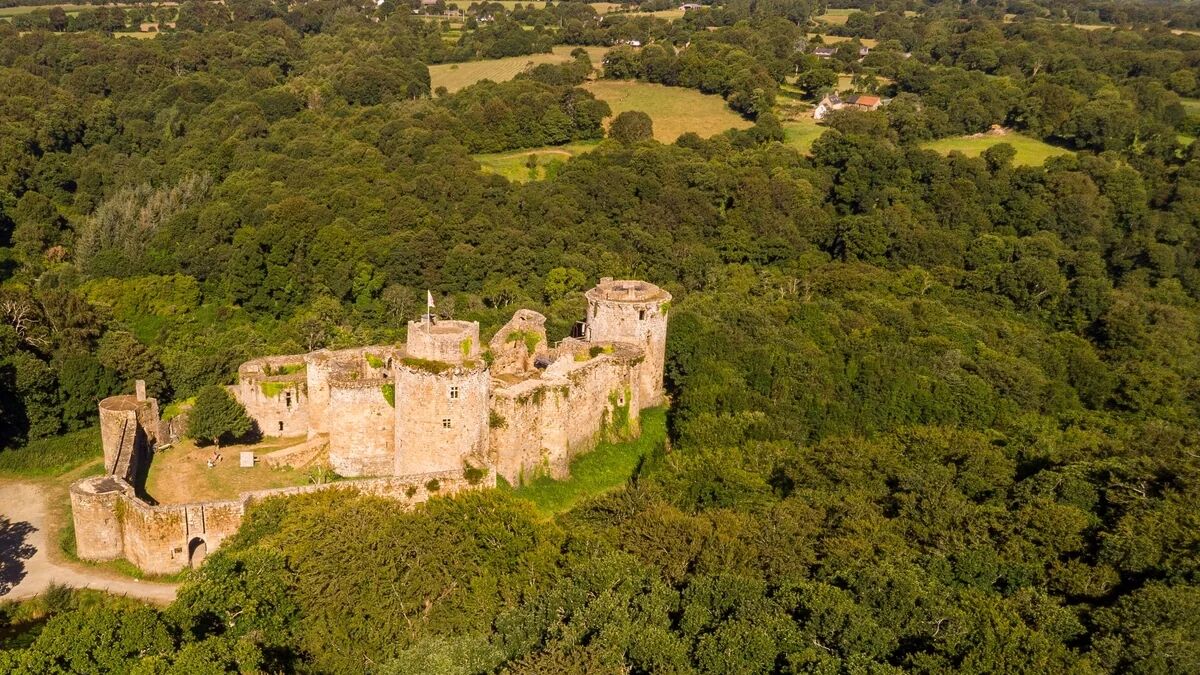
In the heart of the Côtes-d’Armor, a few kilometers from Lannion, there stands a fortress that looks like it was lifted from a historical film. With its eleven towers, its ramparts and its wooded surroundings, Tonquédec Castle ranks among the most impressive remnants of Breton heritage. And even though Guillaume de Tonquédec is not the owner today, unlike his residence in the Yvelines, this home did indeed belong to his ancestors. A story that blends Breton nobility, destructions, inheritances, and the preservation of a remarkable monument.
Guillaume de Tonquédec: the eleven-tower castle bearing his family name
Set on a rocky spur overlooking the Léguer valley, Tonquédec Castle captivates at first by its scale. Surrounded by forest, the ancient fortress comprises a vast fortified enclosure punctuated by eleven stone towers. Visitors can still glimpse the remnants of its walls, its defensive works, and its former entrances. To reach the seigneurial residence in the past, one had to pass through gates protected by drawbridges. Aarchitectural ensemble that recalls the castle’s strategic role in medieval Brittany.
The construction of the castle began in the XIIth century, driven by the Coëtmen-Penthièvre family, members of Breton nobility. But the fortress did not endure the centuries without trouble. At the end of the XIVth century, it was dismantled by order of Duke Jean IV of Brittany, following conflicts between great seigneurial families. Its reconstruction started in 1406, continuing through the XVth century. The successive owners then reinforced its defenses and gradually adapted the facilities to the evolving art of war. In the sixteenth century, the castle was modernized to confront the rise of artillery.
A fortress destroyed by order of Richelieu, then bought back by the actor’s ancestors
The castle’s story took a new turn in the XVIIth century. Considered a stronghold capable of threatening royal authority, the fortress was partially dismantled around 1626 on the orders of Cardinal Richelieu. Its imposing ramparts thus lost their military function, and the estate entered a period of decline. Yet, a few years later, an event would permanently tie the castle to Guillaume de Tonquédec’s name. In 1636, René de Quengo acquired the property, already partly ruined, and added the Tonquédec name to his own. It is thus that the Quengo de Tonquédec branch was created, to which the actor belongs.
The castle then remained associated with this lineage for several generations, before a tumultuous history in the 19th century. After various transfers, the Quengo family sold the domain definitively in 1879 to a merchant who planned to exploit the stones. The monument fortunately escaped that fate. In 1880, the marquis de Keroüartz bought back the ruins and offered them to his daughter Eugénie on the occasion of her marriage to Pierre de Rougé. A symbolic return to the castle’s origins, since the Rougé family themselves descend from the old lords of Coëtmen, the original builders. The castle remains today in their descendants’ hands, and not in Guillaume de Tonquédec’s.
A family castle turned historical monument, a few kilometers from its Breton refuge
Despite the destructions and changes of owners, Tonquédec Castle has preserved much of its medieval character. Classified as a historic monument in 1862, it has undergone safeguarding work for generations. Starting in the 1950s, the Rougé family undertook substantial restoration campaigns to consolidate the masonry and preserve the towers. Today the site welcomes visitors who can discover this exceptional architecture and imagine the daily life of its former inhabitants. A way to keep a heritage alive that might have disappeared in the 19th century.
For Guillaume de Tonquédec, this historical link with Brittany comes with a much more personal attachment to the region. The actor especially enjoys returning to the family home in Trégastel, on the Pink Granite Coast, where his parents own a residence. It is in this landscape of pink rocks and beaches that he spent part of his childhood and learned to swim. Talking about his Breton stays, he told Ouest-France: “It does me good to come back from time to time.” Between memories of vacations in Trégastel and the history of the castle that bears his name, the actor thus maintains a special link with the Côtes-d’Armor. Two very different places, but each tells a part of his family history.
Keep reading
 Home Tours Hélène Ségara: From 161 to 2,691 Sq Ft Paris Apartment, Kitchen Built for Guests to Never Leave — “I Had My Provençal Phase, But My Tastes Have Changed”
 Home Tours Fabienne Carat’s Paris Apartment: 1,615 Sq Ft, Five Bedrooms, Two Entrances, and a Garden — Like a Vacation Home All Year Round
 Home Tours Mélanie Thierry and Raphaël: ‘My Life Feels Like Endless Holidays,’ Their Bréhat Island Refuge for Five Weeks