Everyone’s Seen One at a Relative’s House: Vintage “Trumeau” Mirrors Now Worth Up to €500—If You Can Identify These Specific Models

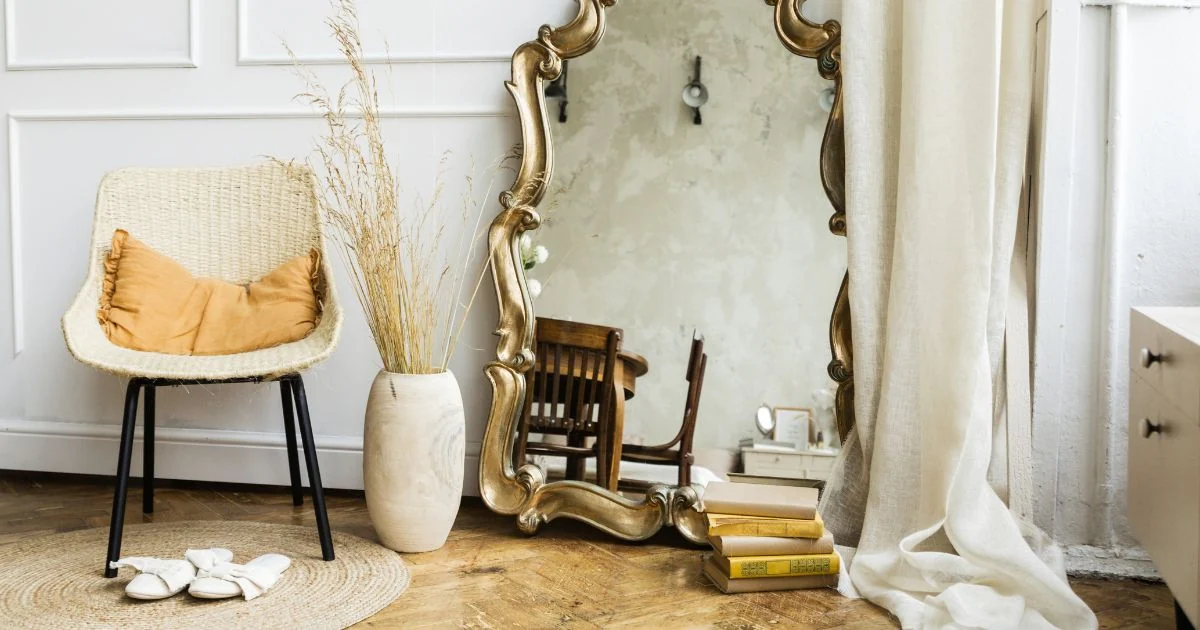
It only takes stepping into a grandparent’s home to encounter this object that you barely noticed as a child, and today it is being snapped up at flea markets and on specialty sites. For a long time associated with old bourgeois houses, the trumeau is finding a second life. Some models, clearly identified, can now reach up to 500 euros, proof that this former pillar of architecture turned decorative mirror has kept its magnetic appeal intact.
The Trumeau Mirror, Heir to a Long Transformation
Originally, however, the trumeau is far from simply being a decorative object. In the Middle Ages, it was a structural element, a massive pillar that separates two doors in large buildings. This role evolves over the centuries. Under the influence of the 17th and 18th centuries, the term comes to denote the wall section between two windows or two doors, before settling on this familiar form: a large mirror placed above a fireplace, framed by a carved or painted panel. It is this blend of function and display, inherited from bourgeois interiors, that still makes it a coveted item today.
As styles succeed one another, the trumeau becomes a canvas for artistic expression. Some feature paintings larger than the mirror itself, while others favor carved woods or gilding that catches the light. The Renaissance favors a rectilinear aesthetic, sometimes punctuated by cherubs. Louis XIV introduces moldings and a romantic iconography dominated by a symmetrical shell at the top. Then come light arabesques and the bright colors of Louis XV, followed by the more geometric restraint of Louis XVI, marked by pearls, heart-shaped lozenges (rais-de-coeur) and gadroons. In the 19th century, the Empire imprints its vocabulary inspired by Antiquity, while the Louis-Philippe and Napoleon III periods reintroduce painting, round the forms and lean on stucco to multiply the ornaments.
Dating a Trumeau: What the Mirror Reveals About Its Age
Spotting these stylistic differences is essential when one seeks to identify an antique trumeau. Observing the mirror provides initial clues: beveled glass becomes widespread by the 19th century, while monumental dimensions exceeding a meter appear after the 18th century. The parquet offers additional hints; irregular, dark boards signal an 18th‑century model, whereas lighter, more regular woods indicate a later manufacture. The materials also betray their era, with stucco decorations taking hold under Napoleon III, while sculptures from earlier periods reveal irregularities typical of entirely handmade work, reports the specialized site Antikeo.
This dating is not merely an expert’s exercise. It is what allows us to understand why some trumeaux gain value and others do not. A richly ornamented Louis XV model or a Louis XVI trumeau with elegant proportions entices collectors, while an Empire piece with columns inspired by antique temples attracts neoclassical enthusiasts. Their price can rise once the whole ensemble—which includes the painting, the frame, and the mirror’s condition—forms a coherent piece representative of its era. Specialist sites abound with trumeaux offered around 300 to 500 euros, sometimes more for the best-preserved pieces.
A Mirror Capable of Reimagining the Atmosphere of a Living Room
Beyond their market value, it is their ability to structure a space that explains their resurgence. Installed above a fireplace, on a bare wall, or even in a bedroom, a trumeau instantly alters the perspective. Its height lends grandeur to the room, its mirror enlarges the volume, and its patina tells a story that converses with even the most contemporary décors. Often, just one well-proportioned model is enough to become the strong focal point of a living room.
This renaissance of the trumeau also reminds us that some pieces once regarded as bulky regain unexpected relevance in our interiors. Their charm is not only decorative. It lies in their capacity to carry the heritage of the ages without going out of style and to adapt just as well to a modern apartment as to an old house. Those who grew up with these mirrors hanging in a relative’s home today discover that they are valuable as much for their aesthetics as for their memory. Sometimes, if the model is right, they’re worth a few hundred euros as well.