Brazilian-Style Laundry Drying: A Space-Saving Trick with a Clothes Drying Rack

A clothes-drying rack that blocks the balcony door, a drying rack in the middle of the living room, cords running across the bathtub… In a small apartment, drying clothes can quickly become a headache. We often end up sacrificing a corner of the living space or investing in a tumble dryer, not always suited to limited spaces or small loads. Yet elsewhere, people have found a smarter way to use the space.
In Brazil, this everyday object is called the varal de teto: a ceiling-mounted clothesline that you lower to hang the laundry and then raise out of the way. It outfits most small laundries, the famous áreas de serviço, and even many balconies. Seen from France, this ceiling system looks almost futuristic, though it boils down to a few metal bars and an ingenious cord-and-pulley setup.
In Brazil, the varal de teto frees up floor space in small apartments
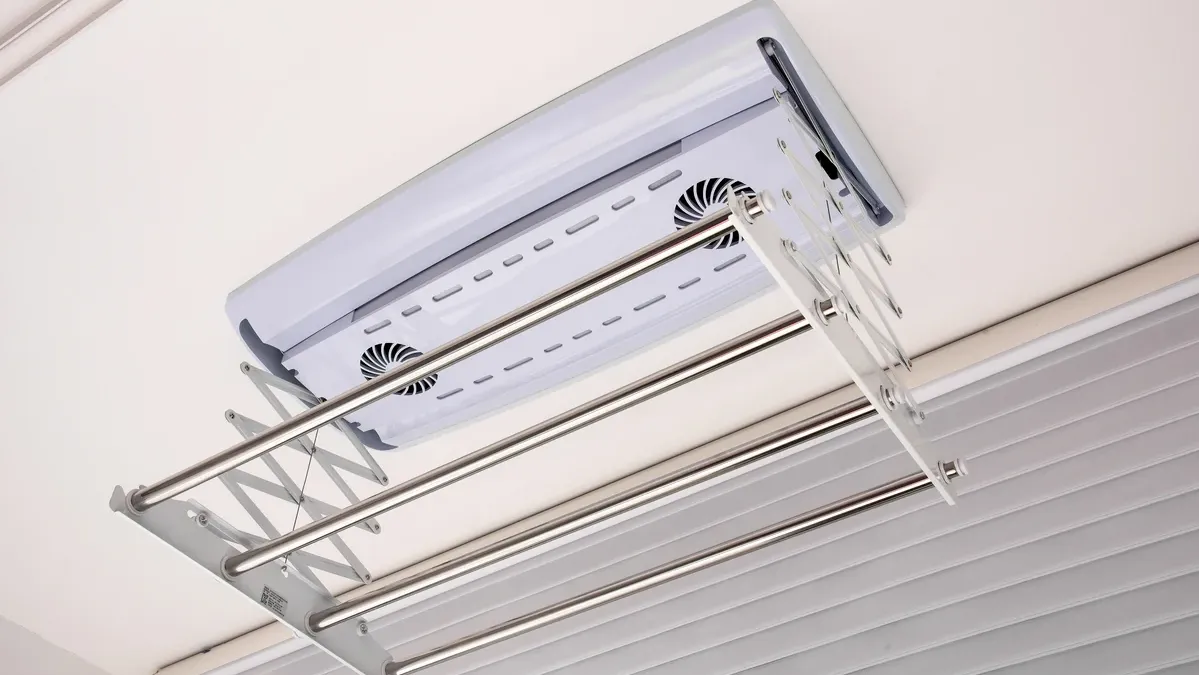
Concretely, a ceiling pulley clothesline consists of several aluminum or painted steel bars aligned like a small clothes dryer, fixed by brackets screwed into the ceiling. Each end is linked to cords that pass through pulleys, themselves connected to a wall cleat. This device is found all over Brazil, especially where the square meters count: urban studios and family apartments with tiny laundry rooms.
The main advantage remains the space gain: the laundry occupies space near the ceiling, an area almost never used, while completely freeing the floor. Movement stays smooth, no wings of the drying rack collide with furniture, and the room appears neater. Placed higher, the clothes also benefit from the warmer air that rises, which can shorten the drying time compared to a model placed on the floor.
How this ceiling-mounted clothesline with pulleys and cords works
In daily use, the action is simple. You pull the cord to lower the structure to eye level, pin the wet garments onto the bars, then pull the cords again to raise the whole unit back toward the ceiling and lock it onto the wall cleat. Some Brazilian models allow each bar to be lowered independently, which requires less effort, and others even integrate a motor controlled by remote control.
To adopt this system at home, you need a sturdy ceiling, appropriate anchors, and to avoid rooms with very high ceilings where handling the cords becomes less practical. Common models measure about 1 to 1.6 m long by 50 cm wide. Experts also recommend leaving 15 to 20 cm of clearance between the laundry and the ceiling to allow air to circulate and moisture to escape.
Choosing a ceiling-mounted clothesline of the varal de teto type for a small dwelling
This type of clothesline is especially suitable for apartments without a real laundry room, compact urban living spaces, and families that run the machine several times a week. Before buying, specialist sites advise checking the nature of the ceiling and whether you can drill, measuring precisely the available length while keeping about 20 cm of margin from the walls, and comparing the load capacity to that of a fully loaded wet machine.
Then comes the choice of comfort level. A simple cord-only model is often enough and costs less than a tumble dryer, while also saving energy. Versions with independent bars make handling easier for people who are shorter or have less arm strength. Electric models inspired by the Brazilian varal de teto can incorporate ventilation or heating to speed up drying.